4-Week Dumbbell Strength

Weights

Classic dumbbell strength training with a flat bench. No rack, no barbell.

Schedule
3 days a week · 4-week cycle
Session
About 42–43 min (Week 4 deload sessions about 29–30 min)
Equipment
Bench + dumbbells
Week 4
Deload week
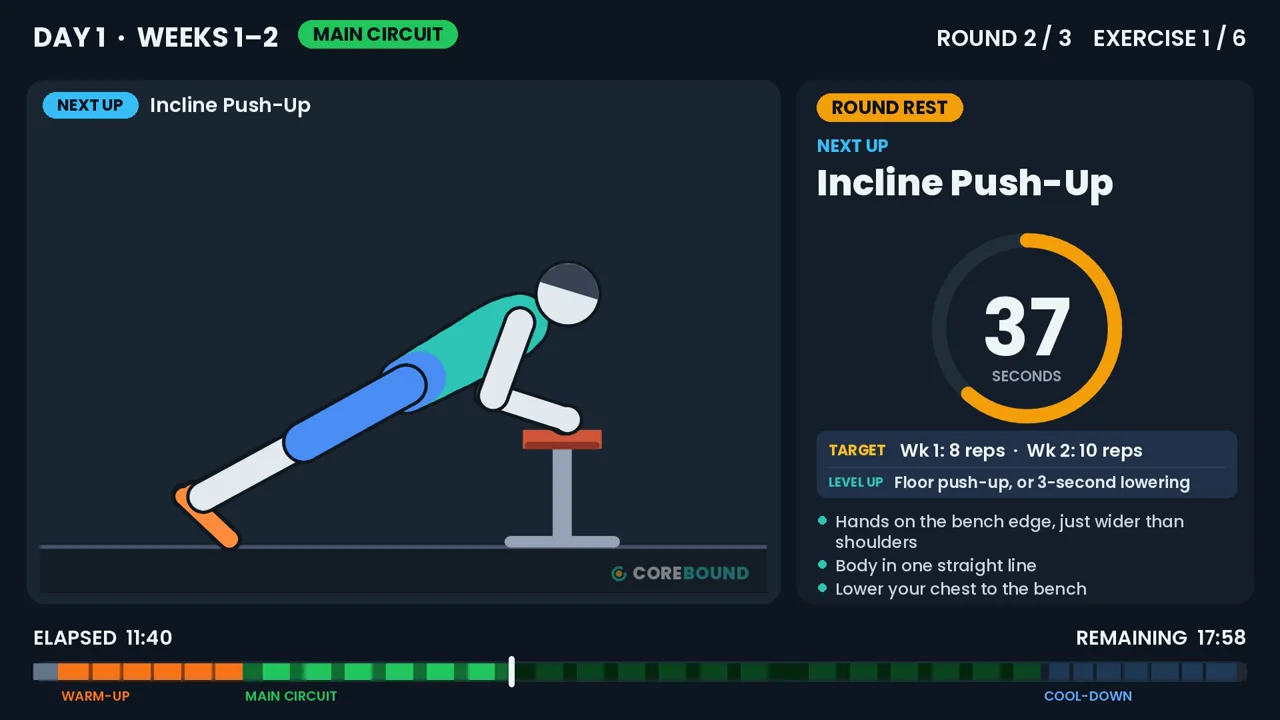
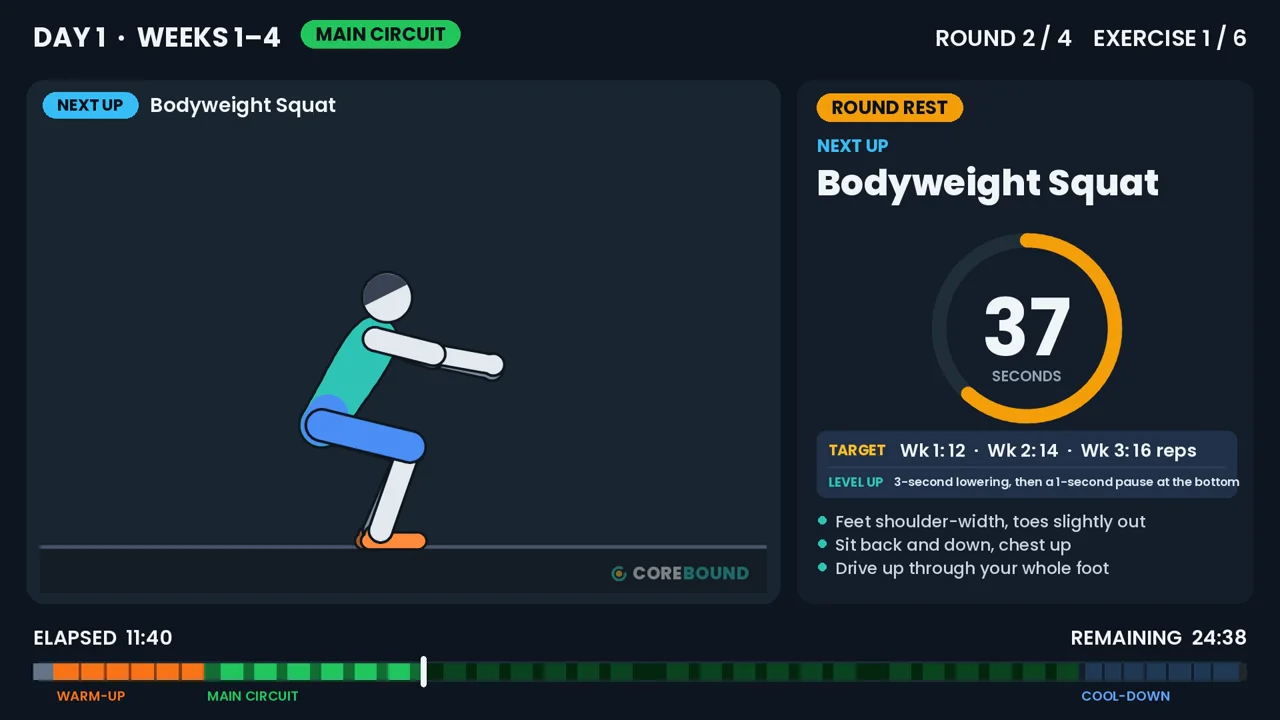
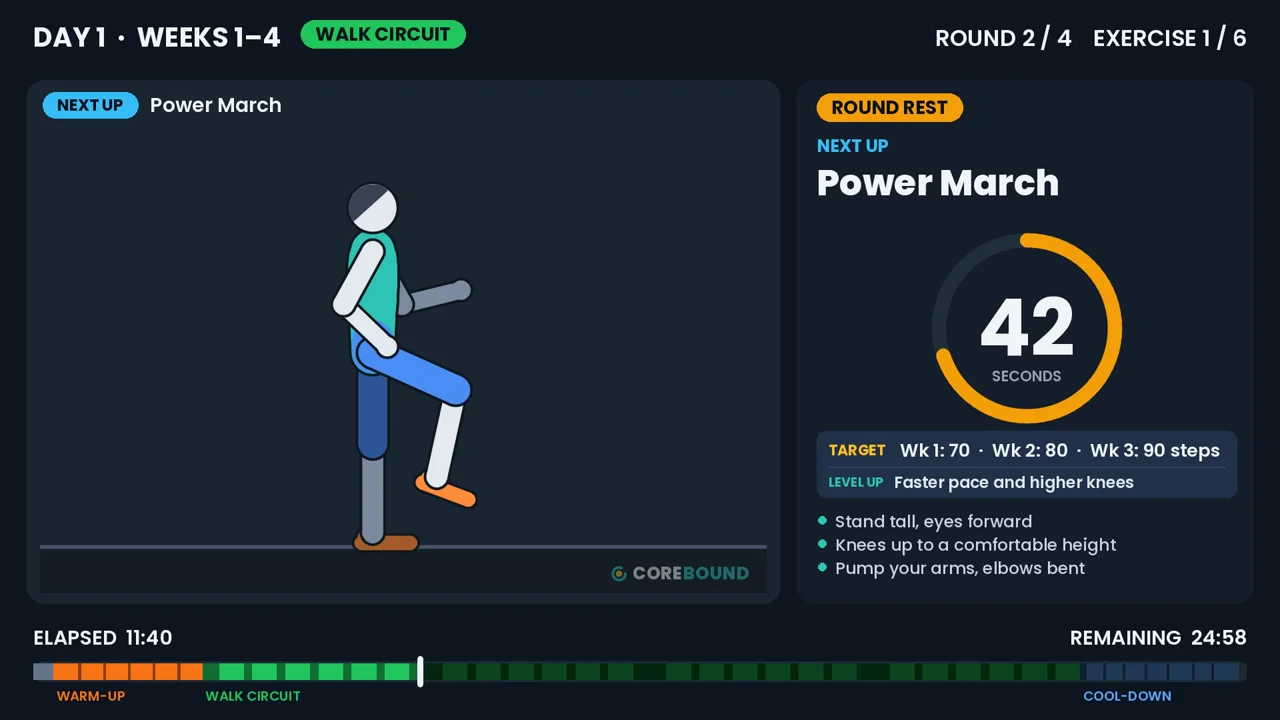
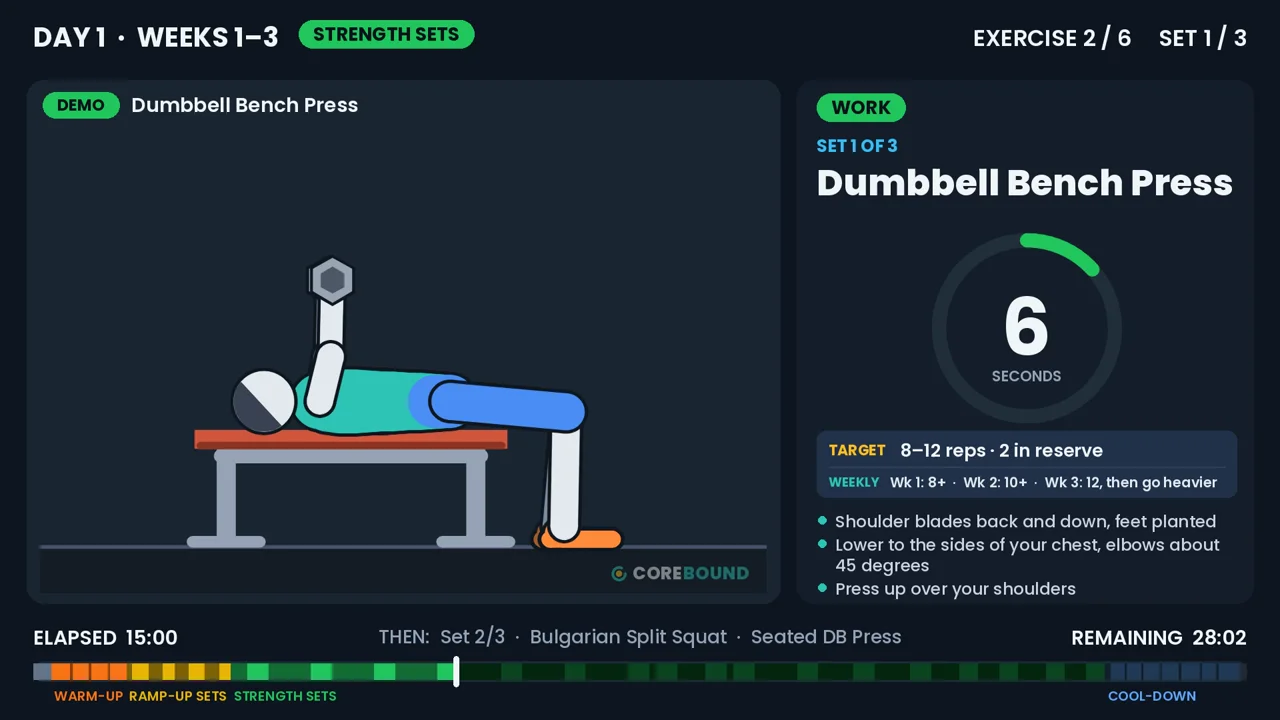
A frame from the Weights Day 1 video: Coach Cole demonstrates a move beside the timer, target and form cues

Who it's for

For anyone with a flat bench and some dumbbells who wants a straightforward, proven-style strength routine: push, pull, legs and hinge, with clear rep targets and a built-in lighter week.

Warm-up, ramp-up sets, straight sets with 45 s / 40 s work windows and timed rests, cool-down.

 Equipment

  • Flat bench
  • Dumbbells (adjustable or a few fixed pairs)
  • A folded towel to pad the dumbbell for hip thrusts
  • No rack or barbell needed

Weekly schedule

Three sessions a week with a rest day in between. The days below are the suggested layout; any three non-consecutive days work.

MonDay 1
TueRest
WedDay 2
ThuRest
FriDay 3
SatRest
SunRest

The 4-week cycle

  1. Week 1

    Find your weights. Pick a weight you could lift about 12 times, but stop at 8–10 reps with 2 in reserve. Write every weight down.

  2. Week 2

    Double progression. Same weights; try to add 1–2 reps per set. Top of the range on every set with about 2 in reserve? Go up the smallest jump next session.

  3. Week 3

    Keep climbing. Add a rep or a little weight wherever form stays clean, and note your best weights.

  4. Week 4

    Deload (videos 04–06). Same exercises, fewer sets, about 80% of your Week 3 weights, 8–10 reps, stopping 3–4 reps short.

What's inside

Every video starts with a warm-up (march in place, arm circles, hip hinge, bodyweight squat) and ends with a cool-down (standing quad stretch, half-kneeling hip flexor stretch, standing forward fold, chest opener, child's pose). Tap any move for its full form guide.

How to progress

"2 in reserve" means you could do about 2 more clean reps. Keep the weight until you reach the top of the rep range on every set, then go up the smallest jump you have (about 1–2.5 kg / 2.5–5 lb per dumbbell; for raises and curls, add reps first) and start again near 8. Missed 8 reps? Drop a little. The work window is a limit, not a quota.

Week 4: deload

Weights uses a deload in Week 4 instead of a max test: a lighter week lets joints and tendons catch up and sharpens technique before you start Cycle 2 a little heavier.

After Week 4, start the next cycle back at Week 1 on the same videos, with slightly heavier dumbbells than you started the last cycle with.

The videos

6 follow-along videos make up the full program. Durations include the warm-up and cool-down.

  • 01Day 1 · Weeks 1–343:02
  • 02Day 2 · Weeks 1–341:57
  • 03Day 3 · Weeks 1–342:04
  • 04Day 1 · Week 4 Deload29:07
  • 05Day 2 · Week 4 Deload29:47
  • 06Day 3 · Week 4 Deload29:54

Watch them on YouTube at @CoreboundFitness.

 Safety

Stop with sharp or joint pain, numbness, chest pain or dizziness; muscle burn is normal, pain is not. For bench and floor presses, kick the dumbbells up from your thighs and lower them back to your chest to finish; never drop them out to the sides with straight arms. Brace the bench against a wall for hip thrusts. Pick dumbbells up and set them down with a flat back, and check the collars on adjustable dumbbells before every set.

If you have an injury or medical condition, are pregnant, or have been inactive for a long time, check with your doctor before starting. This program is general education, not medical advice. See the disclaimer.

YouTube · @CoreboundFitness

Train with Corebound on YouTube

Every Corebound program is a set of follow-along videos: press play, follow Coach Cole and the timer, and you're done. Subscribe at @CoreboundFitness so the next session is always one tap away.